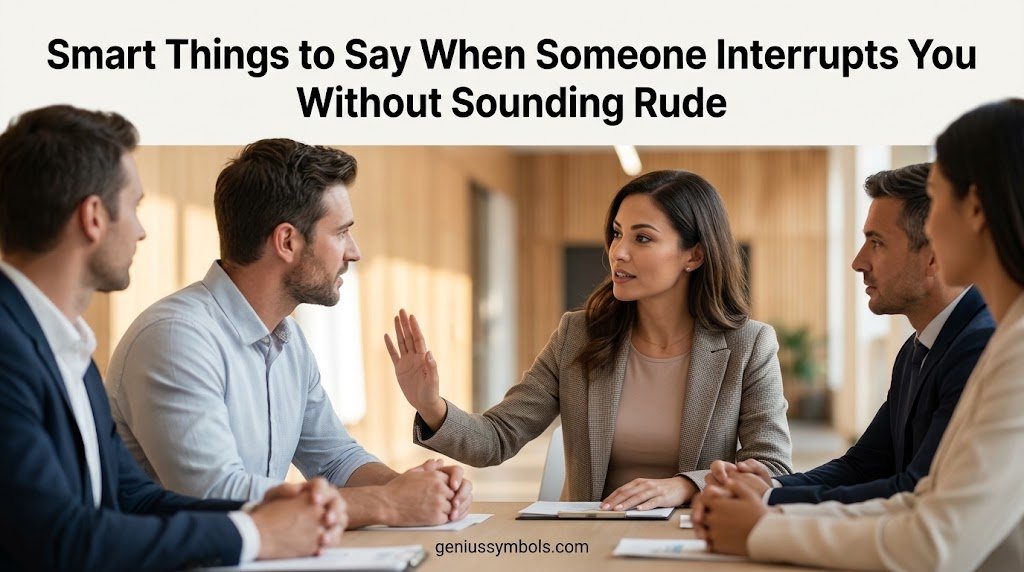
Someone interrupts you in the middle of a sentence, talks over your answer, or jumps in before you finish explaining your point. It can be frustrating, especially when you’re trying to contribute to a conversation without turning it into an argument.
Knowing what to say when someone interrupts you helps you stand up for yourself while keeping your response appropriate to the situation. Sometimes, a simple “Let me finish, please” is enough.
Other times, you may need a confident comeback, a lighthearted remark, or a professional way to reclaim the conversation. Below, you’ll find natural responses for conversations with friends, family members, coworkers, and people who repeatedly talk over you, along with examples to help you choose the right words.
1. Polite Responses When Someone Interrupts You
A polite response is often the best place to start, particularly when you don’t know whether the interruption was intentional. The person might be excited, distracted, or simply unaware that you haven’t finished speaking. You can acknowledge their contribution without giving up your opportunity to finish. Keep your voice calm and your wording friendly. You don’t need to apologize for wanting to complete your sentence. A gentle reminder can restore the conversation without making the other person feel attacked.
Meaning
These responses communicate that you respect the other person’s thoughts but would also appreciate the chance to finish speaking.
Tone
Polite, calm, and considerate.
Example
Person A: I think we should change the plan because—
You: That’s a good point. Let me finish my thought first, and then I’d love to hear yours.
Best Use
Use these replies during casual conversations, family discussions, meetings, or first-time interruptions when you want to keep things friendly.
Here are some polite responses you can use:
- “Let me finish this thought, please.”
- “I just need a moment to finish what I was saying.”
- “I’d love to hear your thoughts right after I finish.”
- “One second, please. I’m almost done.”
- “I appreciate your input. Let me complete my point first.”
2. Confident Ways to Tell Someone to Let You Finish
Sometimes, politeness alone doesn’t work. The other person may keep jumping in, leaving you feeling as though your words don’t matter. In that situation, a confident response helps you reclaim the conversation without insulting anyone. Speak clearly, avoid nervous laughter, and resist the urge to explain why you’re entitled to finish your sentence. Your message can be short because the boundary itself is reasonable. Confidence doesn’t require shouting; a steady voice and direct wording are often enough.
Meaning
These responses make it clear that you expect a fair opportunity to speak.
Tone
Confident, direct, and composed.
Example
Coworker: No, that’s not what we should do. We need to—
You: Hold on. I haven’t finished explaining my suggestion yet.
Best Use
Choose these phrases when someone repeatedly interrupts you, dismisses your ideas, or dominates a discussion.
- “Please let me finish before responding.”
- “I wasn’t finished speaking.”
- “I’d like to complete my point.”
- “Give me a moment to finish what I’m saying.”
- “I’ll listen to you, and I’d appreciate the same courtesy.”
Quick tip: You don’t need to speak louder than the other person. Pause, make your request, and continue when you have the floor.
3. Professional Responses to Interruptions at Work
Workplace interruptions can be especially uncomfortable because you may need to protect your credibility while maintaining a professional relationship. A colleague might interrupt during a meeting, a manager might jump ahead before you’ve explained your reasoning, or a client might repeatedly speak over your updates. Your response should focus on the discussion rather than the person’s character. Avoid sarcasm when the stakes are high. Instead, use language that keeps the meeting moving while ensuring your contribution receives appropriate attention.
Meaning
Professional responses establish a fair speaking turn without creating unnecessary tension.
Tone
Respectful, measured, and assertive.
Example
Colleague: We should just skip that step and move forward.
You: Before we decide, I’d like to finish explaining the risk I noticed with that approach.
Best Use
Use these replies in team meetings, presentations, project discussions, client calls, and one-on-one conversations with colleagues.
- “I’d like to finish my explanation before we move to the next point.”
- “Please give me a moment to complete the update.”
- “I have one more detail that’s relevant to this decision.”
- “Let me finish the context so we’re working with the full picture.”
- “I’ll come to your point next. I just need to finish this part.”
If a colleague consistently interrupts you in meetings, consider speaking with them privately. A calm conversation outside the meeting may solve the problem more effectively than addressing every interruption publicly.
4. Funny Responses When Someone Interrupts You
Humor can take the sting out of an interruption, particularly when you’re talking with friends or people who enjoy playful banter. A funny remark lets the other person know they’ve cut you off without making the moment overly serious. The trick is to keep the joke light. You want the interruption to become the punchline, not the person’s intelligence or personality. If the other person seems angry, dismissive, or genuinely disrespectful, a direct response will usually serve you better than a joke.
Meaning
Funny responses point out the interruption in a playful way while giving you a chance to continue.
Tone
Lighthearted, witty, and casual.
Example
Friend: And then I told him that—
You: Wow, we both bought tickets to the same conversation!
Friend: Sorry! Go ahead.
Best Use
These replies work best with friends, siblings, close coworkers, or people who understand your sense of humor.
- “Hold that thought. My sentence is still loading.”
- “Wait, my story hasn’t reached the commercial break yet.”
- “Easy there, we haven’t reached your speaking turn.”
- “My sentence would like to finish its journey.”
- “One speaker at a time, please. This isn’t a podcast with overlapping hosts.”
Keep your delivery playful. The same words can sound passive-aggressive if you say them with an angry expression.
5. Clever Comebacks for Someone Who Talks Over You
A clever comeback is useful when you want to highlight what’s happening without getting dragged into a lengthy argument. Unlike a harsh insult, a thoughtful comeback draws attention to the conversation itself. It can be especially effective when someone repeatedly assumes they have the right to speak first. Choose wording that feels natural to your personality. The goal isn’t to embarrass the other person; it’s to make space for your own voice and remind everyone that conversations work better when people listen to one another.
Meaning
These responses use concise wording to point out the interruption and reclaim your speaking turn.
Tone
Clever, self-assured, and slightly playful.
Example
Friend: No, listen, here’s what really happened—
You: I’m listening. I’d appreciate the same chance to finish my version.
Best Use
Use these comebacks in casual conversations or discussions where a little wit is welcome and the interruption isn’t part of a serious conflict.
- “Let’s not skip to the response before hearing the whole sentence.”
- “My point deserves an ending before it gets a review.”
- “There’s room for both opinions, but only if we take turns.”
- “You can disagree with my point after you’ve heard it.”
- “Let’s finish one thought before starting another.”
Better choice: If you want to be taken seriously, choose a comeback that highlights the behavior rather than attacking the person’s character.
6. Short Responses That Stop an Interruption
Sometimes, the best response is only a few words long. When a conversation is moving quickly, a long explanation may give the other person another opportunity to interrupt you. Short phrases help you regain the floor without making the moment bigger than it needs to be. Say the words clearly, pause briefly, and continue your original point. You don’t need to provide a speech about conversational etiquette every time someone cuts in.
Meaning
These replies immediately signal that you haven’t finished speaking.
Tone
Direct, calm, and efficient.
Example
Person A: So what I think is—
You: One moment. I’m not finished.
Best Use
Use these phrases during quick discussions, group conversations, phone calls, or meetings where you need to return to your point immediately.
- “Let me finish.”
- “One moment, please.”
- “I wasn’t done.”
- “My turn, please.”
- “Just a second.”
- “Please, let me speak.”
Short responses are particularly useful when someone interrupts unintentionally. If they continue after you’ve asked them to stop, consider using a firmer boundary.
7. Respectful Responses to Someone Who Keeps Interrupting
An occasional interruption is different from a repeated pattern. When someone continually talks over you, a friendly reminder may no longer be enough. You can address the behavior directly while remaining respectful. Focus on what the person is doing rather than making assumptions about why they’re doing it. For instance, saying that you haven’t had a chance to finish is more constructive than accusing someone of never listening. Clear boundaries make your expectations understandable and give the other person an opportunity to adjust.
Meaning
These responses identify the repeated behavior and ask for a change.
Tone
Respectful, firm, and boundary-setting.
Example
Family member: Anyway, as I was saying—
You: I’ve been interrupted a few times now. Please let me finish this time.
Best Use
Use these phrases when a friend, relative, coworker, or acquaintance repeatedly cuts you off despite earlier reminders.
- “I’ve noticed I’m having trouble finishing my sentences. Can we take turns?”
- “I’d appreciate it if you let me complete my thoughts.”
- “I want to hear you, but I need you to hear me, too.”
- “Please wait until I’m finished before jumping in.”
- “I don’t mind a discussion, but I do want a chance to speak.”
If the person continues interrupting after several clear requests, you can pause the conversation or suggest returning to it when both of you can participate respectfully.
Read More: 100 Clean Roasts to Roast Your Brother: Funny, Savage, and Playful Comebacks
8. Calm Responses When Someone Interrupts You During an Argument
Arguments make interruptions more likely because both people may feel eager to defend themselves. You might be explaining your side when the other person cuts in to correct a detail, challenge your memory, or respond to something you haven’t finished saying. Reacting with an insult can quickly turn a disagreement into a fight about manners instead of the original issue. A calm, firm response keeps the discussion focused and gives both people a better chance of being understood.
Meaning
These responses slow the conversation down and reinforce the need for both people to speak and listen.
Tone
Composed, serious, and firm.
Example
Partner: That’s not true! You always leave out the important part.
You: I hear that you disagree. Please let me finish explaining my side, and then I’ll listen to yours.
Best Use
Use these responses during disagreements with a partner, friend, family member, or colleague when the conversation is still respectful enough to continue.
- “I want to understand your side, but please hear mine first.”
- “Let’s take turns instead of talking over each other.”
- “I’m trying to explain what happened, not dismiss your perspective.”
- “Please let me finish before we respond to each other.”
- “We can disagree without interrupting every sentence.”
If the argument becomes threatening, abusive, or too heated to manage safely, you don’t have to keep talking. Taking a break can be the healthier choice.
9. What to Say When Your Boss Interrupts You
Being interrupted by your boss can put you in a difficult position. You may worry that pushing back will seem disrespectful, but staying silent every time can prevent you from sharing important information. The most useful response depends on the situation. If your boss is moving quickly through an agenda, you might briefly flag an unfinished point. If you’re presenting information that affects a decision, explain why the missing context matters. Keep your language focused on the work rather than on whether your boss is being rude.
Meaning
These replies help you maintain professionalism while ensuring your information is heard.
Tone
Diplomatic, confident, and solution-focused.
Example
Boss: Okay, let’s move on to the next item.
You: Certainly. Could I take 20 seconds to finish this point? It affects the recommendation I’m making.
Best Use
Use these phrases during performance reviews, team meetings, presentations, project updates, and conversations with supervisors.
- “Before we move on, may I finish the key detail?”
- “I have one important point that may affect the decision.”
- “Could I complete the explanation, and then I’d welcome your feedback?”
- “I understand. Let me quickly finish the context behind that recommendation.”
- “I want to make sure I’ve explained the relevant information before we decide.”
When interruptions become a recurring workplace issue, keep track of specific examples and consider a private conversation about how to make meetings more productive.
10. Friendly Responses When a Friend Interrupts You
Friends often interrupt because they’re excited, reminded of a similar story, or eager to share their opinion. Not every interruption needs a serious response. In a relaxed conversation, a friendly reminder can help you finish your story without making your friend feel criticized. You can acknowledge their enthusiasm while gently bringing the focus back to what you were saying. However, if one friend consistently takes over every conversation, it’s reasonable to ask for more balanced participation.
Meaning
These replies protect your speaking turn while preserving the warmth of the friendship.
Tone
Friendly, relaxed, and occasionally playful.
Example
Friend: Oh, that reminds me of the time I went there!
You: I want to hear that story, too. Let me finish mine first, and then you’re up.
Best Use
Use these responses with friends during lunch, group chats, casual hangouts, or conversations where people naturally get excited.
- “Wait, let me finish the best part!”
- “I promise your story is next.”
- “Hold on, I’m getting to that part.”
- “Give me another few seconds, then it’s your turn.”
- “I love that you’re excited, but let me land this story first.”
A small amount of warmth can make a reminder feel collaborative rather than confrontational.
11. Responses When a Family Member Interrupts You
Family conversations can come with long-standing habits. A parent may interrupt to offer advice, a sibling may finish your sentences, or a relative may assume they already know what you’re about to say. Because family members often speak casually with one another, interruptions can seem normal even when they leave someone feeling unheard. A useful response depends on your relationship and the topic. You can stay warm while still asking for the chance to express yourself fully, especially during important personal discussions.
Meaning
These replies communicate that being family doesn’t mean one person should control the conversation.
Tone
Warm, respectful, and assertive.
Example
Parent: You don’t need to explain. I already know what you’re going to say.
You: You might know part of it, but I’d still like to explain it in my own words.
Best Use
Use these phrases during family discussions, personal conversations, disagreements about plans, or moments when relatives assume they know your thoughts.
- “Please hear me out before deciding what I mean.”
- “I know we’re comfortable with each other, but I’d like to finish.”
- “Let me explain my side first.”
- “I understand your advice. Can I finish telling you what happened?”
- “I’d like to be heard, even if we don’t agree.”
If family conversations regularly become dismissive, discussing the pattern at a calmer time may be more effective than addressing it in the middle of a disagreement.
12. What to Say When Someone Interrupts Your Presentation
An interruption during a presentation can disrupt your train of thought and make it harder to communicate the main message. Sometimes, a question is genuinely relevant and deserves an answer. In other cases, a person may jump ahead, challenge a detail before hearing the full explanation, or repeatedly redirect the discussion. You can acknowledge legitimate questions while keeping control of the presentation. The most effective response is usually brief, organized, and connected to the material you’re presenting.
Meaning
These phrases help you maintain the structure of your presentation without dismissing the audience.
Tone
Professional, clear, and composed.
Example
Audience member: But how does that compare with the previous quarter?
You: That’s an important comparison. Let me finish this slide, and I’ll address the figures in the next section.
Best Use
Use these responses in business presentations, classroom discussions, training sessions, public speaking, and project demonstrations.
- “I’ll address that in a moment once I’ve covered this point.”
- “That’s a useful question. Let me finish the explanation first.”
- “I want to give that question the right context, so I’ll come back to it shortly.”
- “Let’s hold that question until I’ve shown the complete picture.”
- “I’ll make room for questions at the end of this section.”
If you invite questions throughout your presentation, use these phrases selectively. Answering a relevant question immediately can sometimes make the session more engaging.
13. Responses When Someone Interrupts to Correct You
Being corrected mid-sentence can feel frustrating, especially when the correction is minor or doesn’t change your main point. Still, not every interruption is disrespectful. The person may have noticed a genuine mistake or may be trying to prevent confusion. You can acknowledge useful information without losing your turn to speak. If the correction is irrelevant or premature, calmly return to your original point. This approach keeps the discussion focused on accuracy rather than turning it into a contest over who gets to speak.
Meaning
These responses recognize a correction when appropriate while allowing you to complete your explanation.
Tone
Reasonable, confident, and respectful.
Example
Colleague: Actually, that deadline is Thursday, not Friday.
You: Thanks for correcting the date. My main point is about the work we need to complete before then.
Best Use
Use these replies during discussions involving facts, plans, instructions, presentations, or decisions where accuracy matters.
- “Thanks for clarifying that. Let me finish the larger point.”
- “You’re right about that detail. Here’s what I was getting at.”
- “I appreciate the correction. I have one more part to explain.”
- “Let’s separate that detail from the main issue for a moment.”
- “That may be worth discussing, but I’d like to complete my explanation first.”
Remember: If the correction affects safety, accuracy, or an important decision, address it promptly. Finishing your sentence is less important than preventing a meaningful misunderstanding.
14. What to Say When Someone Interrupts You in a Group Conversation
Group conversations can move quickly. One person starts telling a story, another adds a comment, and someone else jumps in with a related experience. In that environment, interruptions are not always deliberate. However, the same person can end up getting most of the attention while quieter participants struggle to finish a thought. A short, confident response can help you re-enter the conversation without demanding that everyone stop talking for you. You can also use a natural pause to return to the point you were making.
Meaning
These responses help you regain your place in a conversation with several participants.
Tone
Social, assertive, and approachable.
Example
Group member: That’s exactly what happened to me last summer—
You: That’s interesting. Let me finish my part, and then I’d like to hear how it happened to you.
Best Use
Use these replies at parties, dinners, team discussions, study groups, and other social gatherings.
- “Let me finish this thought, then let’s hear everyone else’s take.”
- “I was just getting to the important part.”
- “Can I jump back in for a second?”
- “I’d like to finish what I was saying before we switch topics.”
- “Let’s make room for both stories.”
If a group conversation is informal and everyone is talking excitedly, you may simply wait for a pause and continue. Save firmer language for situations where you repeatedly can’t get a word in.
15. Responses When Someone Interrupts You Over Text
Texting doesn’t involve the same speaking turns as a face-to-face conversation, but interruptions can still happen. Someone might send several messages while you’re typing, respond before you’ve explained the situation, or repeatedly change the subject. Remember that messages sent close together don’t always mean the person is intentionally talking over you. They may be responding to what they can see at that moment. A useful text response should explain what you still need to say without sounding unnecessarily irritated.
Meaning
These messages signal that you haven’t finished explaining your point and would appreciate a chance to do so.
Tone
Casual, clear, and friendly or firm depending on the situation.
Example
Friend: No, wait, I know what you mean!
You: Haha, let me finish explaining first. I’m not quite at that part yet.
Best Use
Use these responses in SMS, WhatsApp, Messenger, group chats, or online discussions where messages overlap.
- “Wait, let me finish explaining “
- “One sec, there’s a little more to the story.”
- “Hold on, I haven’t finished my point yet.”
- “Let me explain the whole thing before we decide.”
- “I get your point. I just want to finish mine, too.”
Avoid reading too much into message timing. If the conversation is important, a short call may clear up misunderstandings more easily than a long exchange of texts.
FAQs
What is the best thing to say when someone interrupts you?
A reliable starting point is, “Let me finish my thought, please.” It’s clear, polite, and appropriate for many everyday situations. If the person continues interrupting, you can be more direct by saying, “I’ve asked to finish speaking. Please let me complete my point.” Adjust your tone to fit the relationship and setting.
How do you politely tell someone to stop interrupting?
Use a calm, specific request, such as “I’d appreciate it if you let me finish before responding.” Avoid accusing the person of being rude unless you need to address a larger pattern. If the interruption happens repeatedly, explain that you’d like both of you to have equal opportunities to speak.
What is a funny response when someone interrupts you?
You could say, “Hold on, my sentence hasn’t reached the ending yet!” This works best with friends or people who understand your humor. If the conversation is serious or the person is deliberately dismissing you, a straightforward response will usually be more appropriate.
How should you respond when your boss interrupts you?
Remain professional and explain why you need a moment to finish. For example, say, “Could I take a few seconds to complete this point? It affects the recommendation I’m making.” If the interruptions become frequent, consider a private conversation about how to communicate more effectively during meetings.
Should you interrupt someone back when they interrupt you?
Usually, it’s better to reclaim your turn with a brief request rather than deliberately interrupting in return. Talking over each other can make the original issue worse. If the person won’t stop, state your boundary clearly or pause the conversation instead of competing for the floor.
Conclusion
Knowing what to say when someone interrupts you can help you protect your speaking time without turning every conversation into an argument. Start with a polite reminder when the interruption seems accidental, use humor when the relationship allows it, and choose a firm boundary when someone repeatedly talks over you. In professional settings, keep your response focused on the discussion and the information you need to share. Most importantly, you don’t have to choose between being respectful and standing up for yourself. A simple, calm “Please let me finish” is often all you need to make your voice heard.













1 thought on “25 Smart Things to Say When Someone Interrupts You Without Sounding Rude”