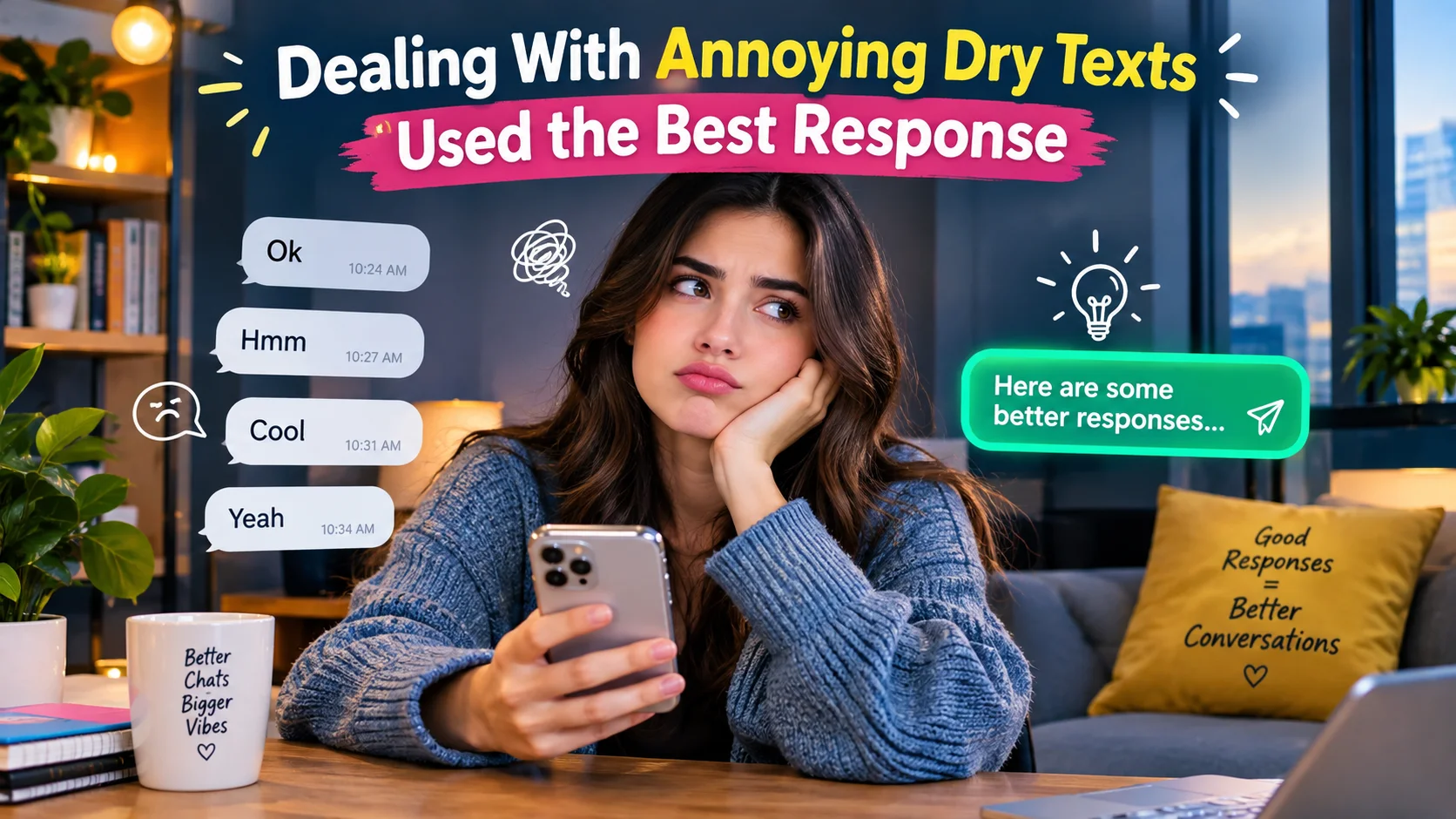
Dealing With Annoying Dry Texts Used the Best Response Dealing With Annoying Dry Texts Used the Best Response helps you stay calm, read the tone, and choose a natural reply that fits the situation.
A dry text such as K, Lol, Okay, Yeah, or Haha can make a conversation feel awkward, but it does not always mean someone dislikes you. They may be busy, tired, distracted, or overwhelmed by work, or simply not great at texting. When texting a crush, friend, partner, or someone you’ve just met, I usually look at the wider interaction before deciding how to respond to dry texts.
A thumbs-up emoji, one-word reply, or dry reply may reflect lack of interest or limited emotional availability, but it can also be temporary. The key is to protect your confidence, avoid misinterpretation, and choose a natural response based on whether they seem interested in talking.
Lets Dive in:
1. Turn Their Short Reply Into a Playful Question
When someone gives you a one-word answer, you do not always need to match their low energy. A playful question can give them an easy opportunity to say more without making the situation uncomfortable. This works particularly well when the person is normally conversational but suddenly starts sending short messages.
Meaning
You are gently pointing the conversation toward something more interesting instead of complaining about their texting style.
Tone
Playful, friendly, curious.
Example
Them: Fine.
You: Fine as in “everything is great” fine, or fine as in “I need snacks and emotional support” fine?
Best Use
Use this with friends, people you are dating, or someone you already have a comfortable relationship with. Avoid it if the other person seems genuinely upset or busy.
2. Ask a Question That Cannot Be Answered With “Yes” or “No”
Sometimes dry texting happens because the questions being asked are too easy to answer. “Did you have a good day?” can produce “yeah,” while “What was the best part of your day?” invites an actual story.
Meaning
You are changing the conversation rather than criticizing the person’s texting habits.
Tone
Friendly, interested, conversational.
Example
You: How was work?
Them: Good.
You: Nice. What was the most interesting thing that happened today?
Best Use
This is useful when you genuinely want to keep talking but the conversation keeps ending after every question.
Quick tip: Ask about experiences, opinions, choices, or stories instead of questions that require only one-word answers.
3. Use a Funny Callout
If you know the person well, a humorous callout can acknowledge the dry texting without making the situation serious. The trick is to joke about the conversation rather than insult the person.
Meaning
You are saying, “I noticed how short these replies are,” but keeping the mood light.
Tone
Funny, teasing, casual.
Example
Them: Lol.
You: That “lol” had the emotional range of a parking ticket.
Best Use
This works best with close friends or someone who understands your sense of humor. It may sound rude with a new acquaintance.
4. Give Them Something Interesting to React To
Instead of repeatedly asking questions, send something that naturally creates a reaction. A funny observation, unusual thought, photo, story, or interesting question can give the other person more material to work with.
Meaning
You are adding energy to the conversation rather than waiting for the other person to carry it.
Tone
Casual, engaging, spontaneous.
Example
You: I just realized something ridiculous: every friend group has one person who would survive a zombie apocalypse and one person who would immediately become the zombie’s best friend.
Them: 😂 Which one am I?
You: I’m still collecting evidence.
Best Use
Use this when the conversation feels stale but there is no obvious conflict between you.
5. Send a Short, Confident Reply and Stop Chasing
You do not have to keep asking questions when someone repeatedly gives minimal answers. Sometimes the healthiest response is simply to step back.
Meaning
You are showing that you are interested in conversation but do not intend to force it.
Tone
Calm, confident, casual.
Example
Them: Yeah.
You: Gotcha. Catch you later.
Best Use
This is especially useful when you have already tried several ways to keep the conversation going and the other person continues responding with one-word messages.
Better choice: If their behavior is temporary, giving them space may solve the problem without creating unnecessary tension.
6. Ask If They Are Actually Busy
Not every dry texter is annoyed with you. They might be working, driving, studying, dealing with family matters, or simply having a stressful day. A quick check-in can prevent you from interpreting short messages incorrectly.
Meaning
You are checking the situation instead of assuming the worst.
Tone
Considerate, direct, caring.
Example
Them: Okay.
You: You seem a little busy. Want to talk later?
Best Use
Use this when the change in their texting is sudden or noticeably different from their normal behavior.
7. Try a “Choose One” Question
Giving someone two or three options makes replying easier while still encouraging an actual answer. It can be especially useful when a person seems too tired or distracted for a long conversation.
Meaning
You are making the conversation easy to continue without demanding a detailed response.
Tone
Casual, playful, easygoing.
Example
You: Quick question: pizza, burgers, or tacos for tonight?
Them: Pizza.
You: Excellent choice. Now we can discuss the important question: extra cheese or no extra cheese?
Best Use
Use this for casual texting, dating conversations, or friends when you want to get the conversation moving again.
8. Make a Lighthearted “Dry Texting” Joke
If the pattern is obvious, you can address it directly with humor. This can be more natural than pretending you have not noticed.
Meaning
You are acknowledging the low-energy conversation without turning it into an accusation.
Tone
Playful, teasing, confident.
Example
Them: K.
You: I see we’re writing a novel today. Chapter one: “K.”
Best Use
This is best with someone who knows you well enough to recognize that you are joking.
9. Use a Clever Challenge
A small challenge can give a dry conversation some playful energy. Instead of asking another ordinary question, invite the person to answer something unusual.
Meaning
You are creating a reason for them to give a more interesting response.
Tone
Clever, playful, competitive.
Example
You: Okay, one-word answers are banned for the next five minutes. Tell me something I don’t know about you.
Them: That’s a tough one.
You: Good. The challenge has officially begun.
Best Use
Use this with friends, dates, or people who enjoy playful conversation.
10. Send a Funny “Emergency” Response
Sometimes exaggerating the situation makes a dry conversation funny without actually criticizing the person.
Meaning
You are playfully pretending that their short messages have created a dramatic situation.
Tone
Funny, exaggerated, light.
Example
Them: Sure.
You: Emergency meeting scheduled. We need to discuss this sudden shortage of words.
Best Use
This works best when your relationship already includes teasing and joking.
11. Ask for Their Opinion Instead of Their Status
Questions like “What are you doing?” often produce “nothing.” Opinion-based questions are harder to answer with a single word because they require a personal reaction.
Meaning
You are trying to learn what they think rather than simply collecting updates about their day.
Tone
Interested, natural, conversational.
Example
You: Random question: would you rather have a four-day workweek or a three-day weekend?
Them: Three-day weekend.
You: Same. What would you do with the extra day?
Best Use
Use this when you want to start a deeper or more interesting conversation.
12. Match Their Energy for a While
Sometimes the best response to dry texting is not to work harder. If someone consistently gives short answers, matching their level of effort can tell you whether the conversation naturally improves when you stop carrying it.
Meaning
You are allowing the conversation to develop naturally instead of doing all the work.
Tone
Relaxed, confident, neutral.
Example
Them: Cool.
You: Yep.
Them: What are you doing?
You: Just relaxing.
Best Use
This can be useful when you feel like you have been asking all the questions and keeping the conversation alive by yourself.
Watch the tone: Matching someone’s energy should not become passive-aggressive punishment. The purpose is to stop overextending yourself, not to start a texting competition.
13. Be Direct When Dry Texting Becomes a Pattern
If someone repeatedly gives short, uninterested responses, guessing what they mean can become exhausting. A calm and honest question may be more useful than another clever comeback.
Meaning
You are asking for clarity instead of interpreting their behavior.
Tone
Direct, respectful, mature.
Example
You: I feel like our conversations have been a little one-sided lately. Are you still interested in chatting?
Best Use
Use this when the pattern has continued long enough that it is affecting the relationship or making communication uncomfortable.
14. Give Them Permission to Talk Later
Sometimes people send dry texts because they feel obligated to respond even though they do not have the time or energy for a real conversation. Letting them know that they can reply later can remove that pressure.
Meaning
You are showing consideration while leaving the door open.
Tone
Understanding, relaxed, respectful.
Example
Them: Sorry, busy.
You: No worries. Handle your stuff. We can talk later.
Best Use
This works well with friends, family, coworkers, and romantic partners when you know they genuinely have something going on.
15. Use a Flirty Nudge When the Context Is Romantic
If you are texting someone you are dating, a little playful flirting can sometimes bring more personality into the conversation. Keep it light rather than making the other person feel pressured to perform.
Meaning
You are teasing them while making your romantic interest clear.
Tone
Flirty, playful, confident.
Example
Them: Haha.
You: That’s all I get? I thought I was at least worth a full sentence. 😉
Best Use
Use this only when there is already mutual flirting or romantic interest. It is not appropriate for a professional or unfamiliar relationship.
Read This: 25 Smart & Natural Replies to “Are You Currently Employed?” for Any Situation
16. Respond With a Funny “Interview” Comment
When every answer feels like it has to be pulled out of someone, comparing the conversation to an interview can make the situation amusing.
Meaning
You are highlighting the one-sided questioning in a humorous way.
Tone
Funny, teasing, slightly sarcastic.
Example
You: How was your weekend?
Them: Good.
You: Thank you for attending today’s interview. We’ll contact you about the next question.
Best Use
This is best with someone who appreciates sarcasm. Avoid it when the person may already be irritated or emotionally overwhelmed.
17. Change the Subject Completely
Sometimes the problem is not the person—it is the topic. If the current subject has run out of energy, moving to something completely different can revive the conversation.
Meaning
You are recognizing that the topic is stale and giving the conversation a fresh direction.
Tone
Casual, spontaneous, upbeat.
Example
Them: Yeah, work was okay.
You: Fair enough. New topic: if you could teleport anywhere for dinner tonight, where are you going?
Best Use
Try this when the person responds normally to other subjects but becomes dry whenever a particular topic comes up.
18. Use a Voice Note Instead of More Text
Some people simply communicate better through voice than typing. A short voice message can add emotion, humor, and context that a few words on a screen cannot.
Meaning
You are changing the communication format instead of forcing the same texting pattern.
Tone
Natural, personal, relaxed.
Example
You: I’m giving up on typing this story because it makes no sense in three sentences. Sending a voice note instead.
Best Use
Use this with people who are comfortable receiving voice messages. It can be especially useful for stories, explanations, or emotional conversations.
19. Set a Boundary When the Conversation Feels Disrespectful
There is a difference between someone being naturally brief and someone repeatedly responding in a dismissive or disrespectful way. If the latter is happening, humor may not be the best tool.
Meaning
You are communicating that you expect basic respect without turning the exchange into an argument.
Tone
Calm, firm, respectful.
Example
Them: Whatever.
You: If you don’t want to talk about it, that’s okay. I’d rather you tell me directly than respond disrespectfully.
Best Use
Use this when the problem is not merely short texting but a pattern of dismissive communication.
Better choice: Focus on the behavior rather than attacking the person’s character.
20. Know When Not to Respond
Not every dry text needs a comeback. Sometimes the conversation has naturally ended, and continuing to push for a response creates more awkwardness than simply leaving the message alone.
Meaning
You are recognizing that silence can be a normal part of texting.
Tone
Calm, confident, unbothered.
Example
Them: Cool, thanks.
You: —
There is nothing wrong with letting the conversation end there.
Best Use
Use this when the message is clearly a closing statement or when you have already made several attempts to continue the conversation.
21. Ask a More Personal but Appropriate Question
When casual small talk becomes repetitive, a slightly more personal question can make the conversation meaningful. The key is to respect the level of trust between you.
Meaning
You are moving beyond surface-level conversation and inviting the person to share something genuine.
Tone
Thoughtful, curious, warm.
Example
You: You’ve had a pretty hectic week. What’s something you’re actually looking forward to right now?
Best Use
This works well with close friends, partners, and people you are getting to know. Do not use overly personal questions with someone you barely know.
22. Use a “Tell Me More” Response
You do not always need a clever question. Sometimes the simplest way to encourage conversation is to show genuine interest in what the person has already said.
Meaning
You are giving them space to expand instead of immediately changing the topic.
Tone
Warm, interested, supportive.
Example
Them: Today was kind of weird.
You: Weird how? Tell me what happened.
Best Use
This is particularly useful when someone gives a short response that hints at a bigger story.
23. Tell Them You Prefer Real Conversations
If texting has become consistently frustrating, it may be better to communicate your preference rather than repeatedly trying different tricks.
Meaning
You are honestly explaining what kind of communication works better for you.
Tone
Honest, confident, respectful.
Example
You: I’m not great at endless one-word texting. I’d rather have an actual conversation when we both have time.
Best Use
This is appropriate for dating, friendships, or ongoing relationships where communication style matters.
24. Use a Friendly Exit Instead of Forcing the Conversation
Sometimes the other person simply is not available for conversation at that moment. Ending positively lets both people move on without creating unnecessary tension.
Meaning
You are choosing a clean ending rather than repeatedly trying to restart the exchange.
Tone
Friendly, relaxed, considerate.
Example
Them: Yeah, maybe.
You: No worries. I’ll let you get on with your day. Talk later!
Best Use
This is useful when the conversation feels flat but there is no reason to assume anything negative.
25. Stop Trying to Fix Every Dry Conversation
One of the most useful ways of dealing with annoying dry texts is recognizing that you cannot single-handedly create a two-person conversation. You can ask better questions, change topics, add humor, or communicate directly, but the other person still has to participate.
Meaning
You are accepting that conversation requires mutual effort.
Tone
Mature, confident, realistic.
Example
You: Want to tell me about your day?
Them: Nah, not really.
You: Fair enough. If you feel like talking later, I’m around.
Best Use
Use this approach when repeated attempts have not changed the conversation. Giving someone space is often more useful than sending increasingly frustrated messages.
FAQs:
What is the best way to respond to annoying dry texts?
Start by considering the context. If the person is normally talkative, ask whether they are busy or change the subject. If dry replies are constant, communicate directly or stop carrying the conversation by yourself.
How can I respond to a dry texter without sounding rude?
Use a light question, playful observation, or simple change of topic. Avoid immediately accusing the person of being boring, rude, or uninterested because short texts can have many explanations.
What is a funny response to a one-word text?
You can gently joke about the short reply, such as, “I see we’re keeping today’s conversation beautifully concise.” Humor works best when you already have a comfortable relationship with the person.
Should I keep texting someone who gives dry replies?
It depends on the pattern. If they are temporarily busy, giving them space may be appropriate. If you repeatedly initiate and receive minimal effort, you do not need to keep forcing the conversation.
How do I know if someone is just busy or genuinely uninterested?
Look at their overall communication rather than one message. Consider whether they initiate conversations, respond more fully at other times, make plans, and show interest outside of texting. No single short reply can establish someone’s intentions.
Conclusion:
Dealing with annoying dry texts can be frustrating, but you do not always need to take a short reply personally. A K, Lol, Okay, or one-word response may simply mean the person is busy, tired, distracted, or not in the mood to text.
Instead of overthinking every message, focus on the overall communication and how consistently the person interacts with you. A thoughtful question, funny response, smart reply, or flirty message can sometimes bring the conversation back to life.
However, if someone repeatedly gives dry responses, going quiet or giving them some space may be a better choice than forcing the interaction. The best response is one that protects your confidence, avoids misinterpretation, and keeps your communication natural, respectful, and enjoyable.














1 thought on “25 Dealing With Annoying Dry Texts Used the Best Response”