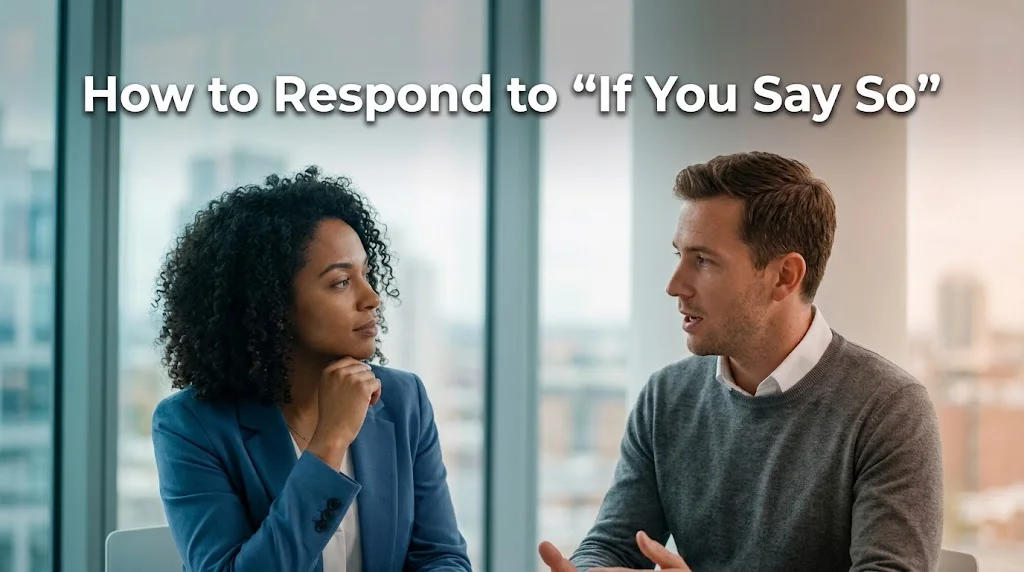
How to Respond to “If You Say So” starts with noticing whether the phrase sounds harmless, skeptical, joking, doubtful, or dismissive in context. When someone says this phrase, its tone can completely change the meaning.
In a casual chat, a friend may use it jokingly as playful teasing, while a skeptical person may show doubt or disagreement by dismissing your point. A useful approach is to look at the situation, conversation, and contextual clues before deciding how to reply. This common phrase can leave you perplexed because of its ambiguity, so wonder about the person’s intent instead of assuming they want to stop arguing.
The psychology behind it often involves uncertainty, attitude, and reaction. The person may be agreeing, avoiding a discussion, or accepting your decision without wanting further discussion.
In a professional setting or serious discussion, calm, confident, and respectful answers can help clarify what they mean and avoid sarcasm. In a casual exchange, natural replies, a funny response, or clever comebacks can keep the dialogue light. These response strategies support better communication by considering intent, interpretation, behavior, engagement, acceptance, and dismissal instead of simply reacting to the words alone.
What Does “If You Say So” Usually Mean?
The phrase “if you say so” can carry several meanings depending on facial expression, previous conversation, and tone. Someone may genuinely accept what you said, but they may also be signaling that they do not fully believe or agree with you.
For example, “If you say so” from a close friend might be playful, while the same words from a coworker could indicate disagreement. Before responding, consider whether the person sounds amused, doubtful, annoyed, or simply finished with the discussion.
Meaning
It can communicate agreement, skepticism, disbelief, resignation, or mild disagreement.
Tone
Usually casual, skeptical, sarcastic, or neutral, depending on context.
Example
Friend: You definitely didn’t eat the last slice of pizza.
You: I absolutely did not.
Friend: If you say so.
Best Use
Use your response to address the actual tone behind the phrase, rather than assuming the person is being rude.
Calm Responses When Someone Sounds Skeptical
When “if you say so” sounds doubtful, there is no need to immediately become defensive. A calm response can acknowledge the skepticism without turning the conversation into an argument.
These replies work particularly well when you want to stand by what you said while keeping the discussion relaxed. They communicate confidence without trying to prove yourself aggressively.
Meaning
These responses show that you are comfortable with what you said and do not feel pressured to argue.
Tone
Calm, confident, direct, and mature.
Example
Friend: You really think that’s going to work?
You: I do. We’ll see how it turns out.
Friend: If you say so.
You: That’s all I’m saying.
Best Use
Good for friends, casual conversations, and disagreements where you want to stay composed.
“Fair Enough” as a Simple Response
Sometimes the smartest response is not another argument. “Fair enough” acknowledges the other person’s reaction while allowing the conversation to move forward.
It is especially useful when you realize that neither person is going to change the other’s mind. Rather than pushing harder, you can accept the difference in opinion.
Meaning
It communicates, “I understand that you don’t agree, and that’s okay.”
Tone
Neutral, respectful, and mature.
Example
Person A: I think the movie was great.
Person B: If you say so.
You: Fair enough. We clearly have different tastes.
Best Use
Use it in casual discussions, disagreements, and conversations where you want to avoid unnecessary tension.
Funny Replies to “If You Say So”
A little humor can completely change the energy of the conversation. If the other person is teasing you rather than genuinely challenging you, a playful answer can keep things enjoyable.
The key is knowing whether your relationship supports joking. A funny comeback between close friends can sound completely different from the same sentence in a serious conversation.
Meaning
A humorous reply turns the skeptical phrase into a playful exchange rather than a disagreement.
Tone
Funny, playful, casual, and teasing.
Example
Friend: You actually finished all that work?
You: Look at me. I’m basically productivity in human form.
Friend: If you say so.
You: Please respect my impressive self-narrative.
Best Use
Best for close friends, siblings, and relaxed texting.
“You Sound Convinced” for a Playful Comeback
If someone says “if you say so” with obvious skepticism, you can gently point out their doubt without becoming confrontational.
“You sound convinced” works because it mirrors their attitude in a playful way. It is short enough for texting and can invite them to explain what they really think.
Meaning
You are lightly acknowledging that they do not seem convinced.
Tone
Playful, teasing, and slightly sarcastic.
Example
Friend: You didn’t spend that much money.
You: I definitely didn’t.
Friend: If you say so.
You: You sound convinced.
Best Use
Use it with friends or people who understand your sense of humor.
Confident Replies When You Stand by Your Words
If you genuinely believe what you said, you don’t need to over-explain yourself. A concise, confident response can show that you are comfortable with your position.
The goal is confidence rather than defensiveness. There is a difference between standing behind your words and trying to force someone else to agree with you.
Meaning
It communicates that you are confident in your statement even if the other person remains doubtful.
Tone
Confident, composed, and direct.
Example
Person A: I don’t think that’s going to happen.
You: I understand. I still believe it will.
Person A: If you say so.
You: I do.
Best Use
Useful in disagreements, personal conversations, and situations where you want to remain firm without escalating.
Short Text Responses to “If You Say So”
Not every conversation needs a long answer. If someone sends “if you say so” by text, a short response often feels more natural than a paragraph explaining yourself.
Choose something that matches the mood. If the conversation is casual, a simple “Yep 😄” may be enough. If the person is being skeptical, “Believe me or don’t” sends a stronger message.
Meaning
Short replies keep the exchange moving without giving unnecessary attention to a minor disagreement.
Tone
Casual, direct, and conversational.
Example
Them: If you say so.
You: Yep, that’s my story. 😄
Best Use
Best for texting, messaging apps, social media, and casual conversations.
Polite Responses When You Don’t Want an Argument
Sometimes you can tell the other person disagrees, but arguing will accomplish nothing. A polite answer allows you to acknowledge their position while keeping your own.
This approach is particularly useful when you want to preserve the relationship rather than win the conversation.
Meaning
You recognize that they have a different opinion without creating further conflict.
Tone
Polite, respectful, calm, and diplomatic.
Example
Coworker: I’m not sure that approach will work.
You: I understand your concern. Let’s see how it goes.
Coworker: If you say so.
You: That’s fair. We can revisit it if needed.
Best Use
Suitable for workplace conversations, acquaintances, and respectful disagreements.
Clever Replies That Keep the Conversation Going
A clever response can turn “if you say so” into an opportunity for conversation. Instead of defending yourself, invite the other person to explain why they are skeptical.
This works particularly well when you actually want to know what they think. It also prevents the conversation from becoming a battle over who is right.
Meaning
You are encouraging the other person to explain their perspective.
Tone
Clever, confident, and conversational.
Example
Friend: If you say so.
You: You don’t sound convinced. What makes you think otherwise?
Best Use
Good for meaningful conversations, friendships, and discussions where you want clarification.
Sarcastic Responses for Close Friends
Sarcasm can be entertaining when both people know it is playful. A light sarcastic comeback can match the energy of “if you say so” without making the exchange serious.
Still, sarcasm is highly dependent on tone. What sounds funny between friends can easily sound hostile when written to someone who does not know you well.
Meaning
You are playfully returning the skepticism rather than treating it as a serious challenge.
Tone
Sarcastic, playful, bold, and teasing.
Example
Friend: You think you’re always right?
You: Naturally. It’s one of my many talents.
Friend: If you say so.
You: Finally, someone recognizes my greatness.
Best Use
Best for close friends and playful conversations. Avoid it when the relationship is already tense.
Respectful Boundary-Setting Responses
If “if you say so” is being used repeatedly to dismiss everything you say, a more direct response may be appropriate. You can point out the communication problem without insulting the other person.
A boundary-setting response should focus on the conversation rather than attacking the person’s character.
Meaning
You are asking for more direct and respectful communication.
Tone
Direct, respectful, and serious.
Example
Person A: If you say so.
You: If you disagree, that’s okay. I’d rather you tell me directly.
Best Use
Useful when someone is repeatedly dismissive, passive-aggressive, or unwilling to communicate clearly.
Friendly Replies That Defuse the Tension
Sometimes the person isn’t truly angry—they simply have a different opinion. A friendly response can prevent a small disagreement from becoming bigger than it needs to be.
You can acknowledge the difference and move on to something more positive.
Meaning
You are choosing friendliness over winning the argument.
Tone
Friendly, relaxed, and positive.
Example
Friend: If you say so.
You: We’ll agree to disagree. No hard feelings.
Best Use
Ideal for friends, family, and casual disagreements.
“You’ll See” for a Confident Response
When you believe time will prove your point, “You’ll see” can be a natural response. It works best when the statement concerns something that can actually be observed later.
Avoid using it as a way to sound superior. The goal is confidence, not a challenge.
Meaning
You are saying that future results may confirm your position.
Tone
Confident, playful, and slightly challenging.
Example
Friend: I don’t think you’ll finish it today.
You: You’ll see.
Friend: If you say so.
Best Use
Good for friendly bets, plans, predictions, and light disagreements.
Playful Replies for Texting
Text conversations often lack facial expressions and vocal tone, so playful wording or an emoji can make your intention clearer.
A short line such as “And I stand by it 😌” can communicate confidence without sounding overly serious.
Meaning
You are keeping your position while making it clear that the exchange is playful.
Tone
Playful, casual, confident, and lighthearted.
Example
Them: If you say so.
You: And I stand by it. 😌
Best Use
Works well for casual texting and social messaging.
Flirty Responses to “If You Say So”
In a romantic or dating conversation, “if you say so” can sometimes be teasing rather than genuinely skeptical. A playful response can keep the chemistry going without becoming too intense.
Your reply should match the existing level of flirtation. If the conversation has not been romantic, jumping immediately into a flirty comeback may feel out of place.
Meaning
You are turning their skepticism into playful romantic banter.
Tone
Flirty, confident, teasing, and light.
Example
Them: You’re definitely thinking about me.
You: Maybe a little.
Them: If you say so.
You: You sound like you were hoping I’d admit it.
Best Use
Appropriate for dating, romantic texting, or an established flirtatious conversation.
Professional Responses at Work
In professional communication, “if you say so” can signal disagreement or uncertainty. Avoid matching it with sarcasm, even if the original comment sounds dismissive.
Instead, bring the conversation back to facts, expectations, or next steps. That keeps the exchange productive and reduces the chance of misunderstanding.
Meaning
You are moving the conversation from personal disagreement toward a practical solution.
Tone
Professional, calm, neutral, and solution-focused.
Example
Coworker: I don’t think the client will approve it.
You: Let’s review the requirements once more and make sure we’re covered.
Coworker: If you say so.
You: That’s fine. We’ll use the requirements as our reference.
Best Use
Best for work emails, meetings, workplace chats, and professional disagreements.
When Someone Is Clearly Being Dismissive
If the phrase is being used to shut down the conversation, responding with another joke may not solve the underlying issue. A direct but controlled answer can make your expectations clear.
You don’t need to prove your point or insult the other person. Simply ask for a straightforward response.
Meaning
You are refusing to let vague dismissal replace honest communication.
Tone
Direct, composed, and assertive.
Example
Person A: If you say so.
You: If you disagree, just tell me what you think. I’m listening.
Best Use
Useful in serious conversations or repeated disagreements.
When You Want to End the Conversation
Not every disagreement deserves another round. If you’ve explained your point and the other person is not interested in discussing it, ending the exchange can be the most practical choice.
A simple response prevents the conversation from becoming repetitive.
Meaning
You are choosing to move on rather than continue debating.
Tone
Calm, neutral, and final.
Example
Them: If you say so.
You: That’s fine. Let’s leave it there.
Best Use
Appropriate when a conversation is going in circles or becoming unnecessarily tense.
“That’s What I Believe” for an Honest Answer
When you want to make it clear that your statement represents your own view, this response keeps the conversation grounded. It does not demand agreement from the other person.
It can be especially useful when discussing opinions, preferences, or personal judgments rather than objective facts.
Meaning
You are clarifying that you are expressing your own belief rather than claiming universal truth.
Tone
Honest, calm, mature, and respectful.
Example
Friend: I don’t think that restaurant is worth the price.
You: That’s what I believe, but I get why you feel differently.
Best Use
Good for opinions, preferences, debates, and everyday disagreements.
“You Don’t Have to Agree” as a Mature Response
You don’t need everyone to agree with you. Sometimes explicitly acknowledging that can remove the pressure from the conversation.
This response works particularly well when both people have different perspectives and there is no objective answer to settle the disagreement.
Meaning
You are comfortable with disagreement and do not need validation.
Tone
Mature, confident, and respectful.
Example
Person A: If you say so.
You: You don’t have to agree with me. We can see it differently.
Best Use
Suitable for friends, family, coworkers, and mature discussions.
Lighthearted Replies for Friends
When the exchange is clearly playful, you can exaggerate your confidence for comedic effect. The humor comes from intentionally making your claim sound more dramatic than it really is.
Keep this kind of response for relationships where playful exaggeration is already normal.
Meaning
You are deliberately making the conversation more humorous.
Tone
Funny, exaggerated, playful, and casual.
Example
Friend: You think you can cook better than me?
You: I don’t think. I know.
Friend: If you say so.
You: History will remember this moment.
Best Use
Great for friends, siblings, and playful text conversations.
When You Want Them to Explain Their Doubt
Sometimes “if you say so” is not enough information to know what the person actually thinks. Instead of guessing, ask.
This approach is useful when the topic matters and you would genuinely like to understand their perspective.
Meaning
You are inviting honest feedback rather than responding emotionally.
Tone
Open, curious, calm, and direct.
Example
Them: If you say so.
You: What makes you doubt it?
Them: I just think the timing is wrong.
You: Okay, that’s helpful. Let’s talk about that.
Best Use
Best for important conversations, planning, disagreements, and situations where understanding matters more than winning.
Responses When “If You Say So” Is Clearly a Joke
If the other person is obviously teasing, there is usually no reason to treat the phrase seriously. Match their playful energy with a light response.
A simple humorous answer keeps the conversation moving without creating unnecessary tension.
Meaning
You recognize that the comment is playful and respond in the same spirit.
Tone
Playful, funny, relaxed, and friendly.
Example
Friend: You call that dancing?
You: Absolutely.
Friend: If you say so.
You: Please don’t question my artistic vision.
Best Use
Perfect for friends, parties, casual texting, and humorous conversations.
FAQs:
What is the best way to respond to “If You Say So”?
There is no single response that fits every situation. A calm answer such as “Fair enough” works for a neutral disagreement, while “You don’t sound convinced” can fit playful skepticism. Consider the person’s tone before replying.
How can I give a polite response to “If You Say So”?
Try something like, “That’s okay, we can see it differently.” It acknowledges the disagreement without creating unnecessary tension.
What is a funny response to “If You Say So”?
For a close friend, you could say, “Please respect my extremely questionable confidence.” Keep humorous replies for situations where you know the other person will understand the joke.
Should I keep my reply short?
Usually, yes, especially when the original message is casual. A short response often sounds more natural than a long explanation. If the topic is important, however, asking the person what they disagree with may be more useful.
How do I know whether “If You Say So” is sarcastic?
Look at the conversation before the phrase, the person’s usual communication style, and the wording around it. In text, sarcasm can be difficult to identify, so asking for clarification is sometimes the safest approach.
Conclusion:
Knowing How to Respond to “If You Say So” becomes easier when you pay attention to the person’s tone, situation, and intent.
The phrase can express agreement, doubt, sarcasm, playful teasing, or even a wish to end the discussion, so one response will not fit every conversation. A calm and confident reply works well when the meaning is unclear, while funny responses or clever comebacks can keep a casual exchange light. In a professional setting, choose respectful answers and ask for clarity when needed.
By understanding the context, you can respond naturally without creating unnecessary tension and keep the conversation flowing smoothly.














1 thought on “25 How to Respond to “If You Say So””